echodendron
a forest of pale forms balanced on beams of light listens and remembers
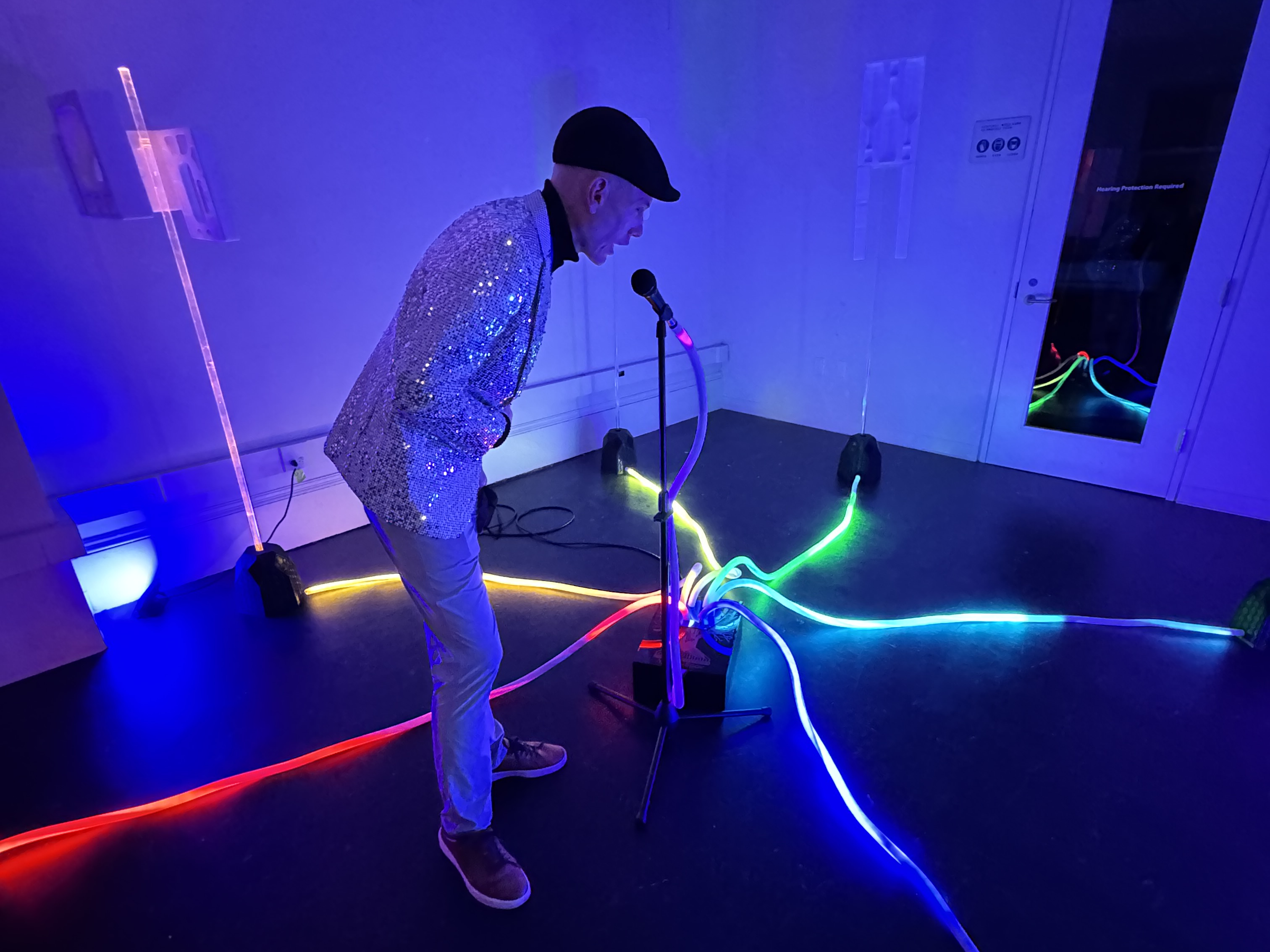
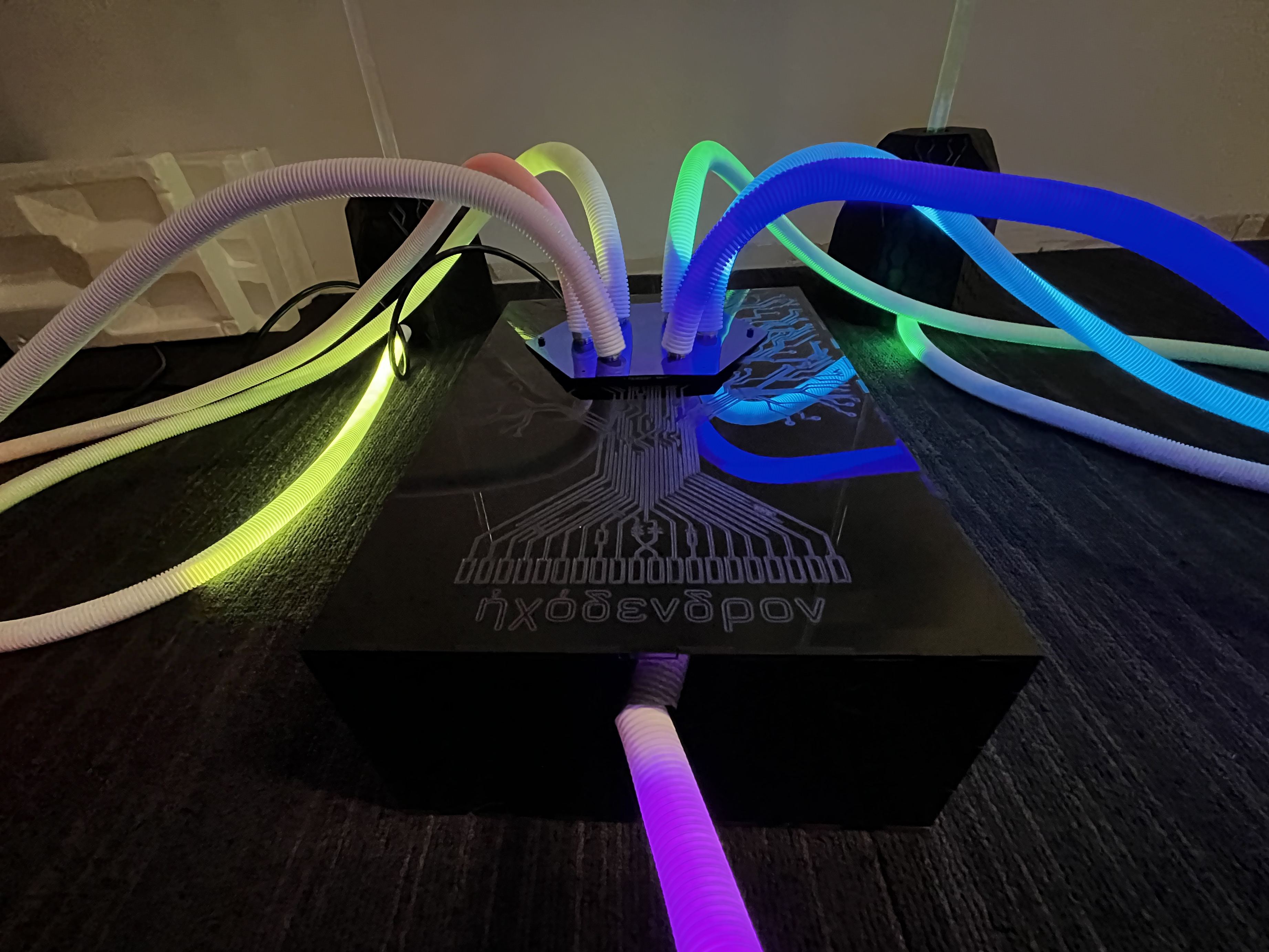
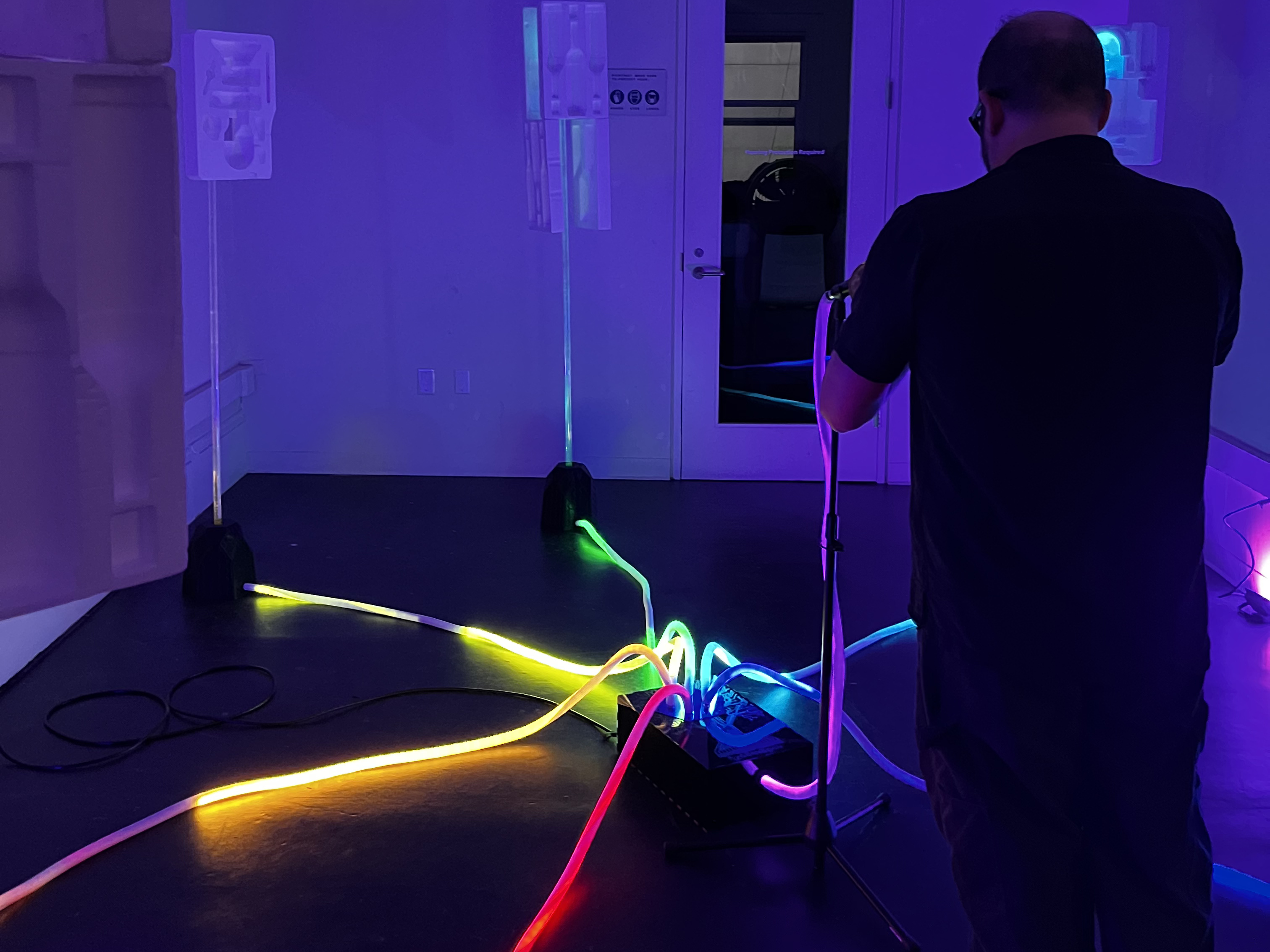
Echodendron is a sonic sculpture consisting of a ring of eight composite polystyrene objects suspended from glowing acrylic rods, connected to a central microphone with glowing tubes.
The piece explores themes of light, sound, time, and persistence. As you approach, the microphone invites you to speak into it. Your words are turned into light traveling down the pole and distributed to the surrounding sculptures. Each mote of light triggers a snippet of your voice, emitted from the objects atop the poles, pulsing in time with the sound. Little granules of sound keep repeating, spinning around you, playing back and forth rhythmically.
After a while, your contribution fades into the whole, and the echodendron recalls little grains of everything it has heard in its lifetime.
Background
In several of my previous projects (Imprints and Quantum Putt) I crafted reactive sound design played through panel exciters as a means to add sound to an installation without visible speakers. In these pieces, the sound design played a supporting role to the main piece, and I was curious to explore a piece that would focus on the sonic element.
I've always been interested in ambisonics and spatial sound, and I was envisioning a site-specific installation that would play custom reactive compositions through exciters attached to objects in the site itself. While experimenting with this idea in my studio, I discovered a novel way to use the transducers to excite objects invisibly (with no wires, speakers or batteries) with remarkable clarity. This discovery formed the core idea of "trees" in a "forest" of sound.
After several iterations on this core technical concept, I settled on introducing reactivity through the sounds of visitors themselves and named it "echodendron"; plausibly constructed as ἠχόδενδρον from the Koine Greek ἠχώ (ēchō) for sound and δένδρον (dendron) for tree.
The sonic environment is constructed by sampling the microphone input into a SuperCollider program. While audio exceeding a certain threshold is detected, it's recorded onto a long buffer acting as a virtual tape loop. This input also triggers small granules of sound to be sampled randomly from close to the recording position and played back spread around the six speaker-trees.
After a small period of silence from the microphone, the code slowly increases the spread of where the sound is sampled from to cover the entirety of the tape loop (which contains all the audio that has been recorded), with a slightly sparser texture. This way, the ambient state of the exhibit is to infinitely remember snippets of its entire memory, creating a soundscape from everything that it has heard.
Future
Part of what I find exciting about this piece is that it serves as a platform for future sonic exploration and even more immersive possiblities. In particular, I'm working on different ways to reactively visualize the signals flowing to the speakers using the built-in lighting controller, as well as exploring more interactive opportunities using an 8x8 lidar distance sensor to detect and react to visitors before they have even spoken into the microphone.
Credits
Development of this solo project was supported in part by a grant from Third Place Technologies for Electric SEA 2026, where it was presented in the showcase exhibition.